Note
Go to the end to download the full example code
Learning with Noisy Labels
This example shows how to reproduce Figures 1 and 2 from the article : “Learning with Noisy Labels” by Natarajan and al.
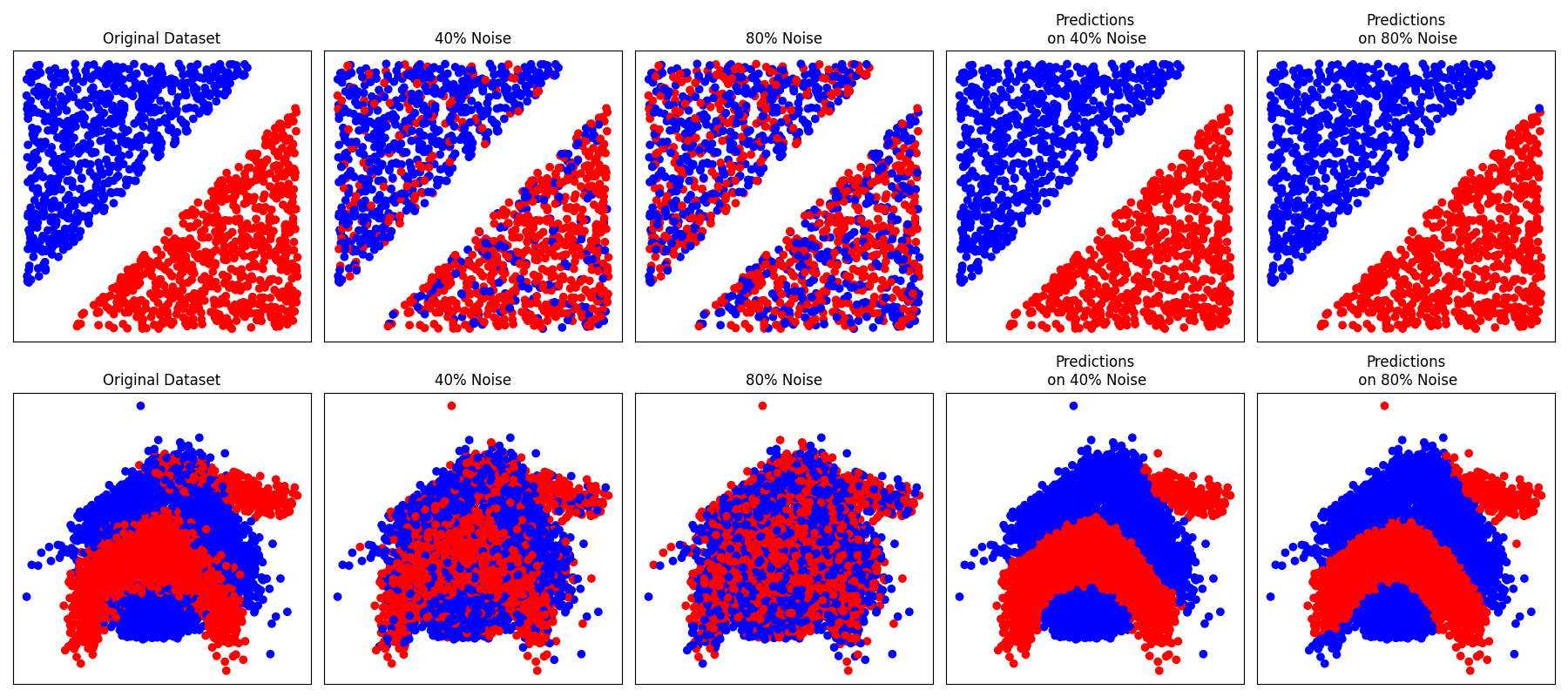
/home/docs/checkouts/readthedocs.org/user_builds/biquality-learn/envs/stable/lib/python3.10/site-packages/biquality_learn-0.0.1-py3.10.egg/bqlearn/unbiased.py:179: FutureWarning: elementwise comparison failed; returning scalar instead, but in the future will perform elementwise comparison
/home/docs/checkouts/readthedocs.org/user_builds/biquality-learn/envs/stable/lib/python3.10/site-packages/biquality_learn-0.0.1-py3.10.egg/bqlearn/unbiased.py:179: FutureWarning: elementwise comparison failed; returning scalar instead, but in the future will perform elementwise comparison
/home/docs/checkouts/readthedocs.org/user_builds/biquality-learn/envs/stable/lib/python3.10/site-packages/biquality_learn-0.0.1-py3.10.egg/bqlearn/unbiased.py:179: FutureWarning: elementwise comparison failed; returning scalar instead, but in the future will perform elementwise comparison
/home/docs/checkouts/readthedocs.org/user_builds/biquality-learn/envs/stable/lib/python3.10/site-packages/biquality_learn-0.0.1-py3.10.egg/bqlearn/unbiased.py:179: FutureWarning: elementwise comparison failed; returning scalar instead, but in the future will perform elementwise comparison
import matplotlib.pyplot as plt
import numpy as np
from numpy.random import RandomState
from sklearn.datasets import fetch_openml
from sklearn.linear_model import LogisticRegression
from sklearn.preprocessing import LabelEncoder
from sklearn.svm import SVC

from bqlearn.corruptions import make_label_noise
from bqlearn.corruptions.noise_matrices import uniform_noise_matrix
from bqlearn.unbiased import LossCorrection

n_samples = 2000
seed = 0
X = RandomState(seed).rand(n_samples, 2)
y = np.empty(n_samples)
margin = 0.15
y = np.delete(y, (X[:, 1] < X[:, 0] + margin) * (X[:, 1] > X[:, 0] - margin))
X = np.delete(X, (X[:, 1] < X[:, 0] + margin) * (X[:, 1] > X[:, 0] - margin), axis=0)

y[X[:, 1] > X[:, 0] + margin] = 0
y[X[:, 1] < X[:, 0] - margin] = 1

figure_1 = (X, y)

figure_2 = fetch_openml(data_id=1460, return_X_y=True, parser="pandas", as_frame=False)

datasets = [figure_1, figure_2]

clfs = [LogisticRegression(random_state=1), SVC(probability=True)]

cmap = plt.cm.bwr
figure = plt.figure(figsize=(18, 8))

for i, (clf, (X, y)) in enumerate(zip(clfs, datasets)):
    y = LabelEncoder().fit_transform(y)

    ax = plt.subplot(len(datasets), 5, 1 + 5 * i)
    ax.scatter(X[:, 0], X[:, 1], c=y, cmap=cmap)
    ax.set_title("Original Dataset")
    ax.set_xticks(())
    ax.set_yticks(())

    noise_matrix = uniform_noise_matrix(2, 0.4)
    y_corrupted = make_label_noise(y, noise_matrix, random_state=seed)
    ax = plt.subplot(len(datasets), 5, 2 + 5 * i)
    ax.scatter(X[:, 0], X[:, 1], c=y_corrupted, cmap=cmap)
    ax.set_title("40% Noise")
    ax.set_xticks(())
    ax.set_yticks(())

    unbiased = LossCorrection(clf, transition_matrix=noise_matrix)
    unbiased.fit(X, y_corrupted)
    ax = plt.subplot(len(datasets), 5, 4 + 5 * i)
    ax.scatter(X[:, 0], X[:, 1], c=unbiased.predict(X), cmap=cmap)
    ax.set_title("Predictions\n on 40% Noise")
    ax.set_xticks(())
    ax.set_yticks(())

    noise_matrix = uniform_noise_matrix(2, 0.8)
    y_corrupted = make_label_noise(y, noise_matrix, random_state=seed)
    ax = plt.subplot(len(datasets), 5, 3 + 5 * i)
    ax.scatter(X[:, 0], X[:, 1], c=y_corrupted, cmap=cmap)
    ax.set_title("80% Noise")
    ax.set_xticks(())
    ax.set_yticks(())

    unbiased = LossCorrection(clf, transition_matrix=noise_matrix)
    unbiased.fit(X, y_corrupted)
    ax = plt.subplot(len(datasets), 5, 5 + 5 * i)
    ax.scatter(X[:, 0], X[:, 1], c=unbiased.predict(X), cmap=cmap)
    ax.set_title("Predictions\n on 80% Noise")
    ax.set_xticks(())
    ax.set_yticks(())

plt.tight_layout()
plt.show()
Total running time of the script: ( 0 minutes 13.579 seconds)