Note
Go to the end to download the full example code
Dynamic Updates in TrAdaBoost
This example illustrates the TrAdaBoost correction from “Adaptive boosting for transfer learning using dynamic updates” by Al-Stouhi and al. to avoid weight drift for untrusted samples. It has been extended to work with a different learning rate and number of classes.
import matplotlib.pyplot as plt
import numpy as np
from matplotlib.animation import FuncAnimation
from sklearn.datasets import make_blobs
from sklearn.model_selection import StratifiedShuffleSplit
from sklearn.preprocessing import StandardScaler
from sklearn.tree import DecisionTreeClassifier

from bqlearn.corruptions import make_label_noise
from bqlearn.tradaboost import TrAdaBoostClassifier

n_samples = 1000
n_classes = 3
learning_rate = 0.5

seed = 0

X, y = make_blobs(n_samples=n_samples, centers=n_classes, random_state=seed)

X = StandardScaler().fit_transform(X)

x_min, x_max = X[:, 0].min() - 0.5, X[:, 0].max() + 0.5
y_min, y_max = X[:, 1].min() - 0.5, X[:, 1].max() + 0.5

trusted, untrusted = next(
    StratifiedShuffleSplit(train_size=0.1, random_state=seed).split(X, y)
)
sample_quality = np.ones(n_samples)
sample_quality[untrusted] = 0

y[untrusted] = make_label_noise(
    y[untrusted], "background", noise_ratio=0.4, random_state=seed
)

fig, ax = plt.subplots(figsize=(4, 4))
ax.set_xlim(x_min, x_max)
ax.set_ylim(y_min, y_max)
ax.set_xticks(())
ax.set_yticks(())
tsc = ax.scatter(X[trusted, 0], X[trusted, 1], marker="s", c=y[trusted])
usc = ax.scatter(X[untrusted, 0], X[untrusted, 1], alpha=0.3, c=y[untrusted])
txt = ax.text(0.01, 0.01, "iteration 0", transform=ax.transAxes)

trada = TrAdaBoostClassifier(
    DecisionTreeClassifier(max_depth=2),
    n_estimators=1,
    learning_rate=learning_rate,
)
trada.fit(X, y, sample_quality=sample_quality)

sample_weight = np.ones(n_samples)
sample_weights = []
max_iter = 30
for i in range(max_iter + 1):
    sample_weight /= sample_weight.sum()
    sample_weights.append(sample_weight)
    sample_weight, _, _ = trada._boost(
        i, X, y, np.copy(sample_weight), sample_quality, seed, {}
    )


def init():
    return ax


def update(d):
    i, sample_weight = d
    tsc.set_sizes(sample_weight[trusted] * 20 * n_samples)
    usc.set_sizes(sample_weight[untrusted] * 20 * n_samples)
    txt.set_text(f"iteration {i}")
    return ax


ani = FuncAnimation(
    fig,
    update,
    frames=zip(range(max_iter + 1), sample_weights),
    init_func=init,
    blit=False,
)
plt.tight_layout()
plt.show()
/home/docs/checkouts/readthedocs.org/user_builds/biquality-learn/checkouts/stable/examples/plot_dynamic_tradaboost.py:86: UserWarning: frames=<zip object at 0x7fd240f27a00> which we can infer the length of, did not pass an explicit *save_count* and passed cache_frame_data=True.  To avoid a possibly unbounded cache, frame data caching has been disabled. To suppress this warning either pass `cache_frame_data=False` or `save_count=MAX_FRAMES`.
  ani = FuncAnimation(
We can verify that the sum of the trusted and untrusted weights is constant given the weight drift correction
sample_weights = np.vstack(sample_weights).T

fig, ax = plt.subplots(figsize=(5, 3))

ax.plot(
    np.arange(max_iter + 1),
    np.sum(sample_weights[sample_quality == 0], axis=0),
    label="untrusted",
)
ax.plot(
    np.arange(max_iter + 1),
    np.sum(sample_weights[sample_quality == 1], axis=0),
    label="trusted",
)

ax.set_xlabel("Iterations")
ax.set_ylabel("Sum of Weights")
ax.legend()

plt.tight_layout()
plt.show()
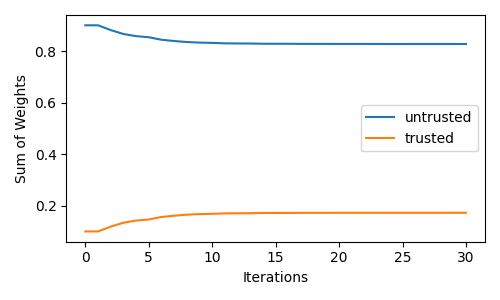
After few iterations, they both converge to a constant value.
Total running time of the script: ( 0 minutes 7.716 seconds)