Note
Go to the end to download the full example code
Effect of Synthetic Corruptions on Toy Dataset
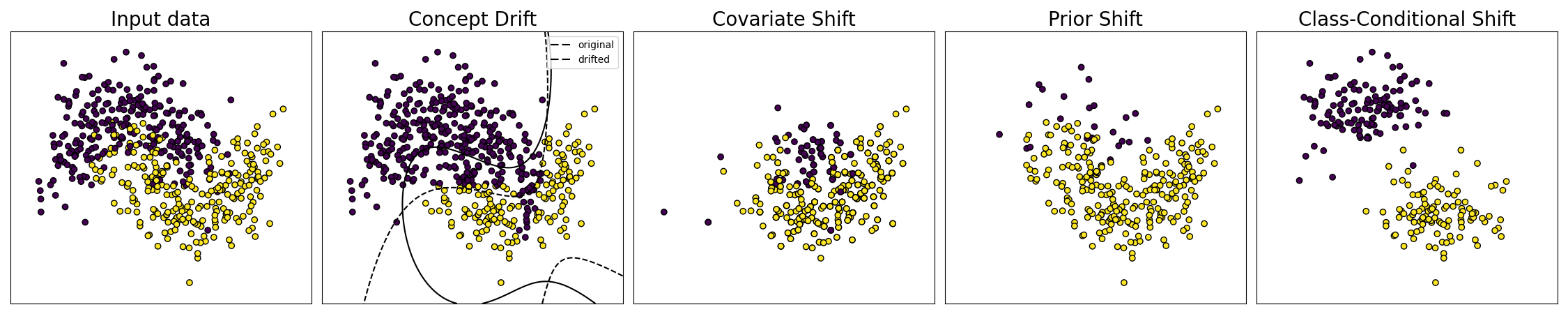
/home/docs/checkouts/readthedocs.org/user_builds/biquality-learn/envs/latest/lib/python3.10/site-packages/sklearn/cluster/_kmeans.py:1412: FutureWarning: The default value of `n_init` will change from 10 to 'auto' in 1.4. Set the value of `n_init` explicitly to suppress the warning
  super()._check_params_vs_input(X, default_n_init=10)
/home/docs/checkouts/readthedocs.org/user_builds/biquality-learn/envs/latest/lib/python3.10/site-packages/sklearn/cluster/_kmeans.py:1412: FutureWarning: The default value of `n_init` will change from 10 to 'auto' in 1.4. Set the value of `n_init` explicitly to suppress the warning
  super()._check_params_vs_input(X, default_n_init=10)
import matplotlib.pyplot as plt
import numpy as np
from sklearn import clone
from sklearn.datasets import make_moons
from sklearn.preprocessing import StandardScaler
from sklearn.svm import SVC

from bqlearn.corruptions import (
    make_cluster_imbalance,
    make_imbalance,
    make_instance_dependent_label_noise,
    make_sampling_biais,
    noisy_leaves_probability,
)

seed = 2

names = [
    "Concept Drift",
    "Covariate Shift",
    "Prior Shift",
    "Class-Conditional Shift",
]
corruptions = [
    lambda X, y: (
        X,
        make_instance_dependent_label_noise(
            noisy_leaves_probability(
                X,
                y,
                noise_ratio=0.5,
                purity="descending",
                min_samples_leaf=20,
                random_state=seed,
            ),
            y,
            "background",
            random_state=seed,
        ),
    ),
    lambda X, y: make_sampling_biais(X, y, a=2, b=4, random_state=seed),
    lambda X, y: (
        make_imbalance(y, X, majority_ratio=10, random_state=seed)[1],
        make_imbalance(y, X, majority_ratio=10, random_state=seed)[0],
    ),
    lambda X, y: make_cluster_imbalance(
        X, y, per_class_n_clusters=3, majority_ratio=10, random_state=seed
    ),
]

n_samples = 500
n_classes = 2

datasets = [
    make_moons(n_samples=n_samples, noise=0.3, random_state=0),
]


figure = plt.figure(figsize=(4.5 * (len(corruptions) + 1), 4.5 * len(datasets)))

i = 1
# iterate over datasets
for ds_cnt, ds in enumerate(datasets):
    # preprocess dataset, split into training and test part
    X, y = ds
    X = StandardScaler().fit_transform(X)

    x_min, x_max = X[:, 0].min() - 0.5, X[:, 0].max() + 0.5
    y_min, y_max = X[:, 1].min() - 0.5, X[:, 1].max() + 0.5

    h = 0.02
    xx, yy = np.meshgrid(np.arange(x_min, x_max, h), np.arange(y_min, y_max, h))

    ax = plt.subplot(len(datasets), len(corruptions) + 1, i)
    if ds_cnt == 0:
        ax.set_title("Input data", fontsize=20)
    # Plot the input points
    ax.scatter(X[:, 0], X[:, 1], c=y, edgecolors="k")
    ax.set_xlim(xx.min(), xx.max())
    ax.set_ylim(yy.min(), yy.max())
    ax.set_xticks(())
    ax.set_yticks(())
    i += 1

    # iterate over corruptions
    for name, corruption in zip(names, corruptions):
        ax = plt.subplot(len(datasets), len(corruptions) + 1, i)

        X_corrupted, y_corrupted = corruption(X, y)

        # Plot the corrupted data
        ax.scatter(
            X_corrupted[:, 0],
            X_corrupted[:, 1],
            c=y_corrupted,
            edgecolors="k",
        )

        if name == "Concept Drift":
            clf = SVC(kernel="poly", degree=3, coef0=1)
            clean_clf = clone(clf).fit(X, y)
            drift_clf = clone(clf).fit(X_corrupted, y_corrupted)
            Z_clean = clean_clf.decision_function(np.c_[xx.ravel(), yy.ravel()])
            Z_clean = Z_clean.reshape(xx.shape)
            Z_drift = drift_clf.decision_function(np.c_[xx.ravel(), yy.ravel()])
            Z_drift = Z_drift.reshape(xx.shape)

            c1 = ax.contour(xx, yy, Z_clean, levels=0, colors="black")
            c2 = ax.contour(
                xx, yy, Z_drift, levels=0, linestyles="dashed", colors="black"
            )
            h1, _ = c1.legend_elements()
            h2, _ = c2.legend_elements()
            ax.legend([h1[0], h2[0]], ["original", "drifted"])

        ax.set_xlim(xx.min(), xx.max())
        ax.set_ylim(yy.min(), yy.max())
        ax.set_xticks(())
        ax.set_yticks(())
        if ds_cnt == 0:
            ax.set_title(name, fontsize=20)
        i += 1

plt.tight_layout()
plt.show()
Total running time of the script: (0 minutes 0.826 seconds)